
An Epigenetic Way to Contrast Aging

Histone acetyl-transferase p300, that generates cellular senescence in aged tissue, is a possible drug target to counteract aging degeneration.
Senescence, a natural process that occurs in all phases of life, is characterized by a durable cell cycle arrest due to many stress factors, such as DNA damage, telomere erosion and epigenetic changes [1]. Senescence cells show loss of laminin B1, high levels of β-galactosidase, chromatin reorganization outside coding regions with new chromatin landscape, histone modification and production of inflammatory cytokines (the latter is typical of SASP: Senescence-Associated Secretory Phenotype). This phenotype in young cells is a defensive mechanism against cancer development because SASP cells can be eliminated by immune-system (IS). On the other hand, aged tissues display an accumulation of senescence cells, in part due to replicative exhaustion and epigenetic changes, that cannot be removed by IS cells. This phenomenon is called Replicative-Senescence (RS) and lead to a degeneration distinctive of aging.
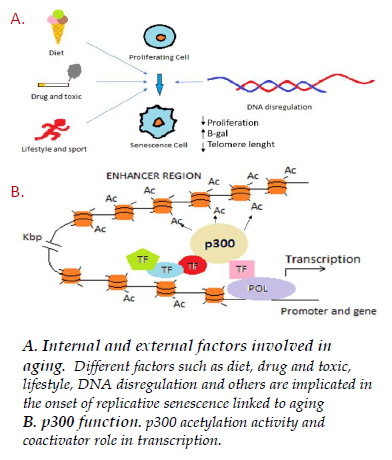
colleagues have published an interesting article where they have investigated the role of HAT p300 in cellular senescence, using IMR90 regarding this possibility Payel Sen and colleagues [1] have published an interesting article where they have investigated the role of the acetyl transferase p300 in cellular senescence in IMR90 cells (primary lung fibroblasts), in order to discover whether p300 can be used as candidate target for anti-aging therapy.Aging is significantly influenced by epigenetic modifications and two theories have been raised about it (Figure, panel A). The first one associates external factors such as lifestyle, alimentary habits, exercise, use of drugs or toxic to epigenetic changes that can modulated aging process. Instead, the second attributes aging to uncontrolled chromatin opening that primes to an abnormal transcription of senescence factors. This second assumption opens the possibility to address some questions: are there epigenetic factors regulating senescence in aging tissues? Is there any way to delay senescence?
Briefly, p300 (and its paralog CBP) is a histone acetyl transferase that modifies histone mainly in enhancer regions and a co-factor during gene transcription [2] (Figure, panel B). In this work the researchers demonstrated that p300 activates de novo super-enhancers to drive cellular senescence. Moreover, they demonstrated, for the first time, the non-redundancy of p300 and its unique functional role in this process despite previous scientific evidences that p300 and CBP had the same functions. Particularly, in RS cells p300 actives some functional metabolic pathways like NOX4, FAR2, and PEX2 productions whose byproducts contributing to senescence and cell cycle arrest. They did both loss of function and gain of function experiments of p300 or CBP. Cells harbouring p300-shRNA show delayed senescence with increased replication capacity and lifespan (RLS) that in any case lead to an immortalization. Instead, p300 overexpression implies decreased replication capacity and decreased RLS, although it is not sufficient to cause an early senescence. All that does not occur with CBP, demonstrating the exclusive role of p300 in RS. Super-enhancers (non-coding regions with high number of enhancers) gain both CBP and p300, but the second is the major driver of de novo enhancer formation in senescence. To support this, knockdown (KD) experiments of p300 in stable RS cells showed that depleting p300 causes a decrease in RNA expression of target genes, although does not without revert the senescent phenotype, while CBP KD did not significantly decrease he expression of senescence genes. Acoording to the authors p300 not only induces de novo the super-enhancers, but also increases their activity multi-acetylating the target histones corresponding to these non-coding regions.
This study is well set up and the researchers have done many experiments using a lot of different techniques, including bioinformatics and statistical analysis, making an accurate scientific research helpful to better understand p300 roles in aging related diseases, increase lifespan, and quality of life. There are still many questions without answer and lot of discoveries about aging mechanisms that remain to be done. p300 is a pleiotropic gene that shows two opposite functions depending on the phase of life: during youth it has a positive role for the correct cellular working and genes expression; subsequently it actively contributes to senescence and cellular degeneration. It is known that p300 is fundamental in embryonic development, therefore a genetica silencing is impossible. For this reason, to contrast aging degeneration, it would be necessary to find efficient drugs usable in in vivo experiments (only in adult phase of life) able to generate a selective p300 blockade in specific cell types. This also considering the complexity of cellular microenvironment, interactions among proteins and extracellular/intercellular signalling.
In possible future studies, it should be addressed the mechanism by which p300 is recruited to the enhancers in the different phases of life eliminating, in this way, negative consequences raised by p300 downregulation including its possible role in cancer degeneration since some tumours show mutated p300. Thus, blocking p300 specific recruiting mechanisms it could be possible to eliminate its negative roles in senescence maintaining its essential and positive functions in cells.
References
- Treccani,“Invecchiamentodellecelluledell’individuo”,AndreaLevi(2010)
- Sen et al. “Histone Acetyltransferase p300 Induces De Novo Super-Enhancers to Drive Cellular Senescence”, Molcecular Cell, 73, 684-698 (2019)
- Tini et al. “Association of CBP/p300 Acetylase and Thymine DNA Glycosylase Links DNA Repair and Transcription”, Molecular Cell vol.9, 265-277 (2002)