
Investigatin G-Quadruplexes with G4Access: A new frontier in Genomic Research
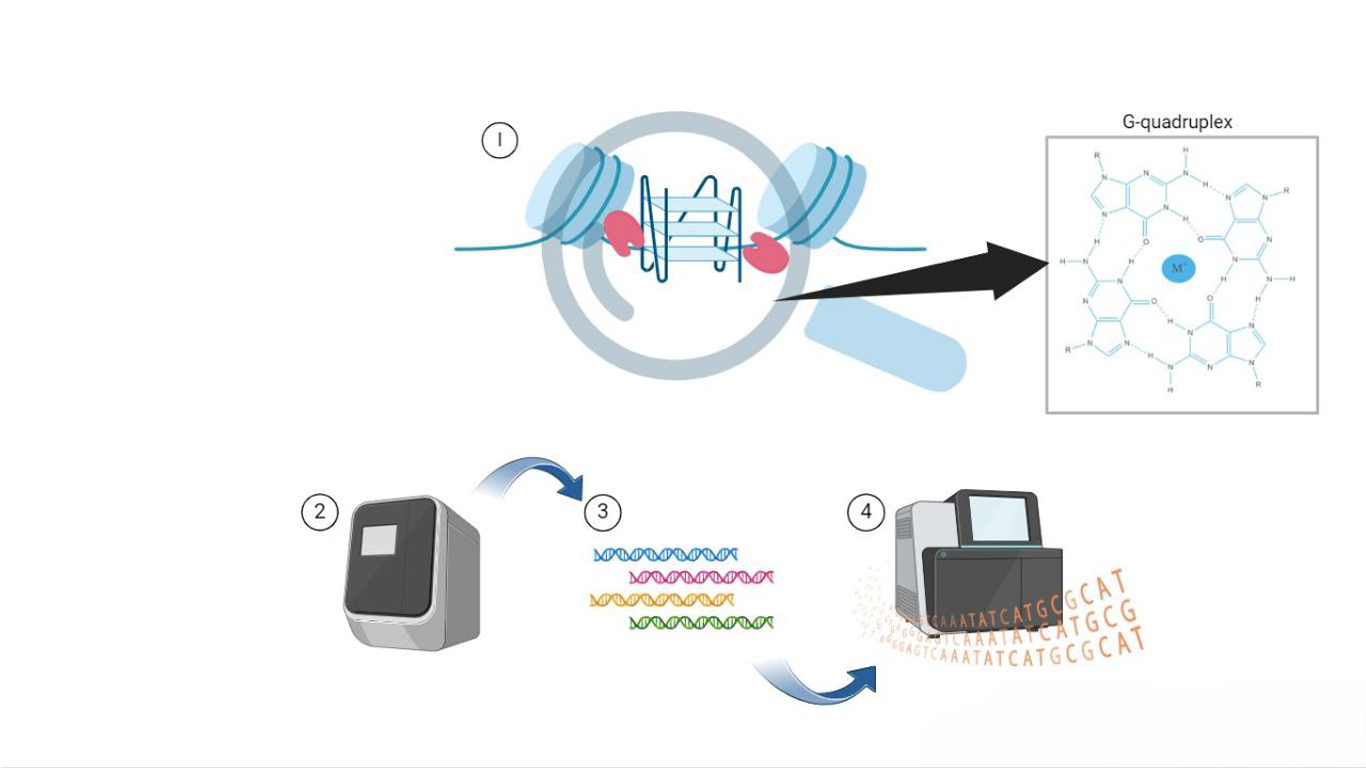
Figure 1 – Schematic representation of G4access method: 1, low level of micrococcal nuclease (MNase) digestion. 2, sequences’ amplification through qPCR. 3, preparation of DNA libraries. 4, analysis of sequences with Illumina NextSeq-500 Sequencer (Created in Biorender.com).
Abstract
Metazoans’ genomes are enriched in particular DNA secondary structures called G-quadruplexes (G4s) that can be found both in telomeres and in promoters, and have a key role in telomeres maintenance and gene transcription. The identification of G4s is currently done by sequenced-based predictive algorithm or antibody-based sequencing methods. Esnault et al. developed a new antibody-independent method, called “G4access” to detect G4 forming sequences (G4Fs) in the genome. They applied it also to study the relationship between nucleosomes exclusion, RNA-Polymerase II positioning and G4s as well as the role of G-quadruplexes in the imprinting regions in stem cells and their relationship with DNA methylation. A better understanding of G-quadruplexes may provide new targets for therapy in the context of cancer, senescence, neurodegenerative diseases and pathogens infections.
Review
G-quadruplexes (G4s) are particular DNA secondary structures located principally in telomeres and in promoter regions and are important because they are involved in telomere maintenance and in the regulation of transcription. Over years, several techniques have been developed with lot of limitations: G4-ChIP, for example, is not accurate because is antibody-dependent and antibodies are not specific for all G4 structures [2]; predictive methods like G4Hunter are not based on experimental approach. Consequently, researchers’ idea is to develop a new method to better characterize all the G4s in the genome, including those G4s located near transcription starting sites (TSSs) where CpG islands and G-rich sequences are concentrated.
Method development
The new method is based on micrococcal nuclease (MNase) digestion that has endonuclease and exonuclease activity (Figure 1.1), DNA sequences are amplified by qPCR (Fig. 1.2), then they are subjected to library preparation (Fig. 1.3) and high-throughput sequencing (Fig. 1.4). The idea is that G4s should be enriched in DNA fragments generated by low activity of the MNase enzyme. Since G4s were found mostly in open chromatin this method is called “G4access”.
The method was performed in three human cells lines, k562, HaCat and Raji and the results were compared with G4-ChIP, demonstrating that G4access is more detailed and more efficient. It was then validated in three in vitro assays using FRET-MC, and thioflavin T and N-methyl mesoporphyrin IX ligands.
G4access allowed the study of the G4s formation dynamics in vivo. Pyridostatin (PDS) treatment of cells induced a global and local G4 peaks redistribution and an increase of weaker G4s as well as a stabilization of the stronger ones. Knock-down of DHX36 and WRN helicases with siRNA, increased G4 structures formation, especially in promoters.
G4, nucleosomes exclusion and transcription
G4access-identified regions were associated with gene promoters, nucleosome-free regions and RNA-polymerase II (RNAP2) binding suggesting that G4s are strictly involved in transcription (Figure 2).

Figure 2-Correlation between nucleosomes exclusion, G4-access regions and RNA Polymerase II positioning (Created in Biorender.com).
The method revealed also an important role of non-promoter G4access regions that can be divided into 4 different groups: classes one and four showed weaker nucleosome positioning than classes two and three. Interestingly class one has promoter-like properties and it has a strong nucleosome depletion.
Moreover, due to the association with transcription the study investigates the relationship between G4s and chromatin opening/RNAP2 recruitment, to verify a past hypothesis suggesting that transcription could induce torsional stress that could stabilize G4s formation. The assay with two RNAP2 inhibitors, triptolide (for initiation) and KM05283 (for elongation) showed that at promoter locations, KM05283 doesn’t affect G4 formations, while triptolide reduces them by half. At non-promoter regions, both inhibitors reduce G4s formation by half. These results suggest that the transcriptional inhibition neither abolish G4s or their association with open chromatin, but it only reduces them. So, it suggests a model in which G4 formations precedes RNAP2 recruitment and G4 structures are stabilized by transcriptional activity.
G4 and methylation in mESC
The application of G4acces on hybrid mouse embryonic stem cells (mESC) obtained by crossing two genetically divergent species of mus musculus, for an efficient discrimination among alleles, led to the discovery of a mutual exclusion between DNA methylation and G4 structures formation. Methylation of DNA may not allow the formation of G4 structures.
G4acces and lower eukaryotes
G4access has been successfully applied also in lower eukaryotes, like Drosophila melanogaster and Saccharomyces cerevisiae, to detect better G4s in their genome, even if their density is lower than mammals.
Conclusions
G4access is a solid approach to better understand the role of G4s thanks to the elimination of the use of antibodies. It outperforms also predictive algorithms that for example underestimated G4s presence. However, G4access reliability could be improved by integrating the results from other approaches like machine learning after collecting more data about genome and G4s (regarding ionic concentrations, open chromatin, strand polarities, loops’ composition…) to develop sophisticated predictive algorithms. In addition, the K+ concentration, during the extraction procedure, should be closer to physiological concentration to avoid overestimation.
The method may allow a better understanding of the G4 structures and their role in several biological activities. They are involved in telomeres and in telomerase’s recruiting, with a key role in senescence and preaging. It’s important in cancer development and neurodegenerative diseases due to numerous proteins which can unwind them. They’re also enriched in oncogenic promoters [2]. G4 structures are involved in DNA transcription and replication of pathogens’ genomes. For these reasons G4s can be considered as possible targets against these diseases, with a particular attention to development of ligands. Their use has not been approved yet because they are not totally safe, they have poor selectivity for promoters, and they also may have different affinity for various conformations. Their precise role in vivo remains elusive and it has been explored in detail yet [3].
References
- Esnault, Cyril, et al. “G4access identifies G-quadruplexes and their associations with open chromatin and imprinting control regions.” Nature genetics8 (2023): 1359-1369.
- Sato, Koichi, and Puck Knipscheer. “G-quadruplex resolution: From molecular mechanisms to physiological relevance.” DNA repair (2023): 103552.
- Yan MP, Wee CE, Yen KP, Stevens A, Wai LK. G-quadruplex ligands as therapeutic agents against cancer, neurological disorders and viral infections. Future Med Chem. 2023 Nov;15(21):1987-2009. doi: 10.4155/fmc-2023-0202. Epub 2023 Nov 7. PMID: 37933551.